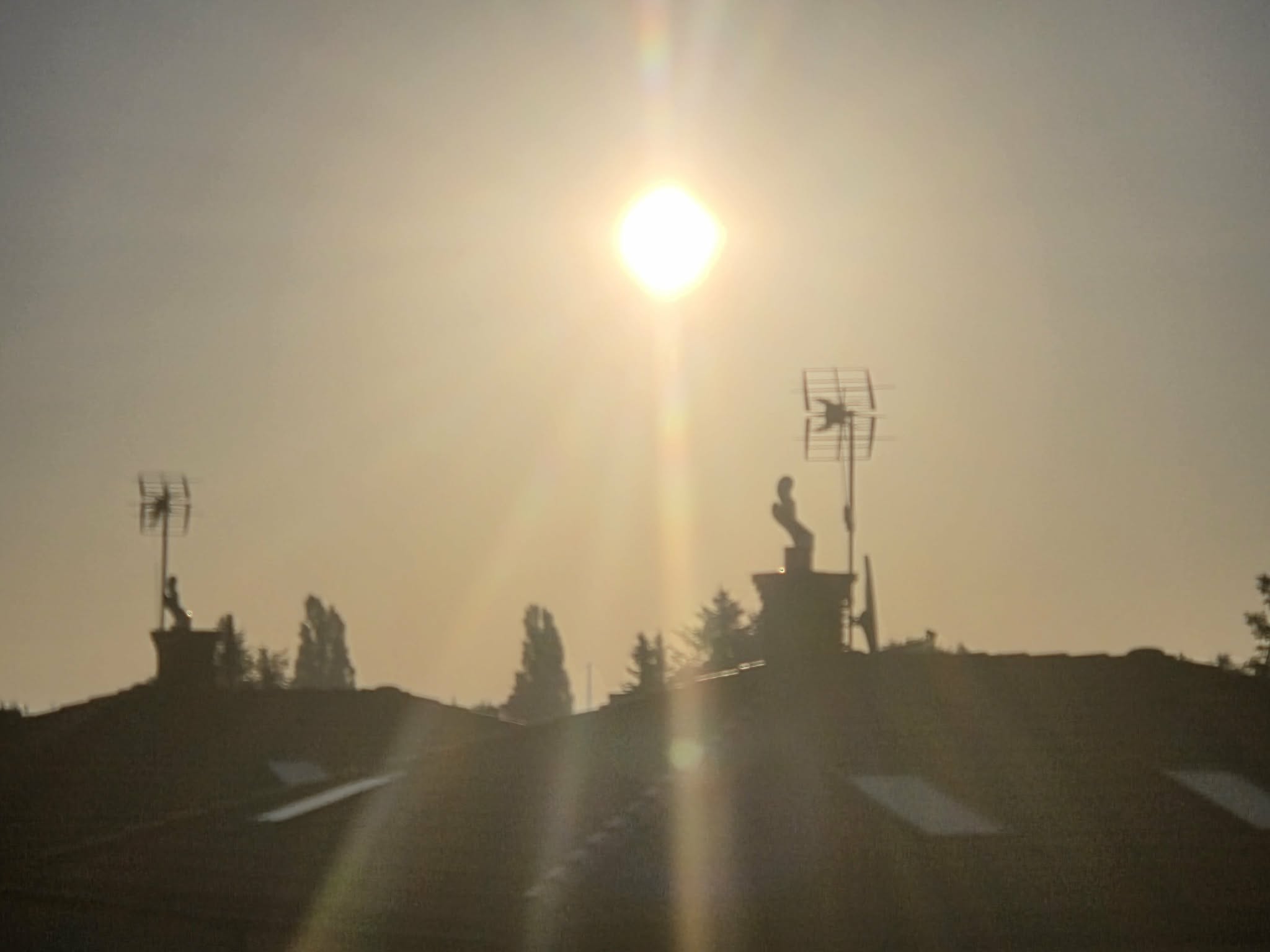
The thing that rises behind your house, warms your face and asks you to sit outside in your underpants is a star.
It is about 4.6 billion years old, roughly 1.39 million kilometres across, and contains about 99.86% of all the mass in the Solar System. You could fit around a million Earths inside it by volume. We are approximately 150 million kilometres away. Thanks Google for that. It rises everyday. That I knew before I asked.
Sunlight takes about eight minutes and twenty seconds to reach us, which means you are looking eight minutes into the past. Google, you are a star too.
At its visible surface, the Sun is about 5,500°C. At its centre it reaches roughly 15 million°C. Mind blowin’. Thanks G.
There, under quite a bit if pressure clearly, hydrogen nuclei fuse into helium. Around 600 million tonnes of hydrogen are converted every second. Most becomes helium; several million tonnes of mass simply disappear into energy. Thanks Einstein (via Google).
That lost mass becomes light and heat.
The Sun is apparently not particularly unusual. It is a fairly ordinary G-type main-sequence star, mostly hydrogen and helium, one among hundreds of billions of stars in the Milky Way.
But there is still plenty we do not properly understand, apparently. Who would have guessed?
But we do know it will not last forever.
In about another five billion years the hydrogen in its core will become exhausted. Apparently. The Sun will swell into a red giant, profoundly altering or destroying the inner planets. Eventually its outer layers will drift away and its remaining core will become a white dwarf.
But that is not today’s problem.
Sometimes the sun is simply there and that is enough. Apparently.

Leave a Reply