Narcissistic, moi? Surely not!
I have been watching myself on my laptop. Never a good look, in all senses.
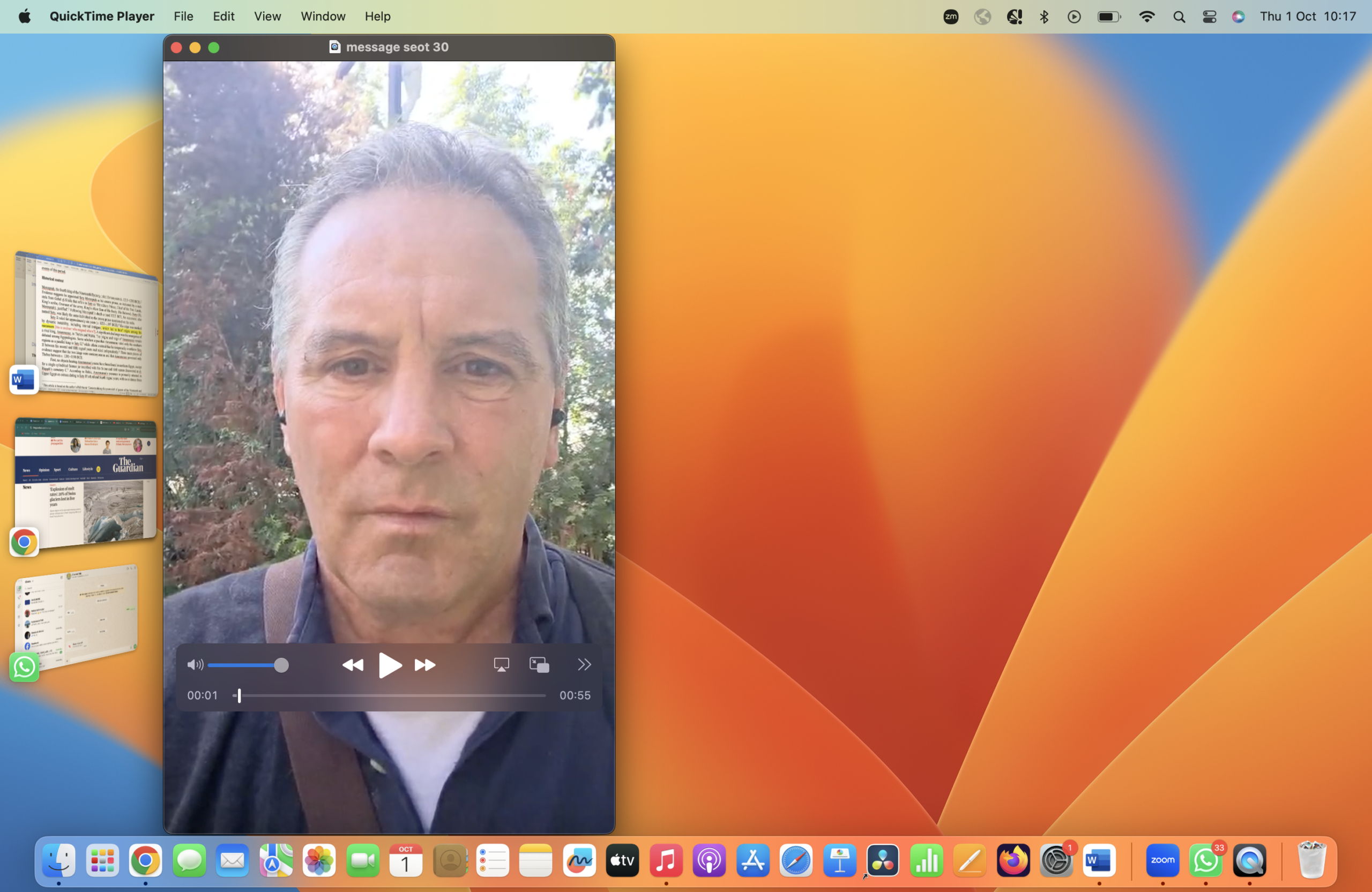
There I am, under a cross in Wawer, where I live. Jesus is on the cross above me. The sun shines through trees. Scenographic me is doing some great work. I look appropriately tired and wounded and extremely sincere, performing sorrow into a telephone. I am explaining that the feelings are still raw, that I am trying to close something. I am also leaving a door open.
It is quite a performance, in a very ‘I am not performing’ kind of way, obviously.
The disturbing thing is that I like it. Not the pain exactly, the image. I watch the face, note the pauses. A very poor Hamlet. The little swallow before a sentence. The exhausted eyes. I recognise the man immediately. I feel sorry for him. I admire him slightly. I also want to tell him to stop talking. Cut, cut, my internal director doesn’t say.
Then I watch it again. Perhaps this time the film will reveal something that was not there before. Or perhaps the same thing, watched often enough, will finally become true.
This is one of the less dignified discoveries of life: you can become your own audience.
The video was real. That matters. I was upset. I meant what I said. The body in the film was not acting in the ordinary sense. It was depleted, frightened, sad, angry, hopeful and trying to preserve some dignity.
But the body watching it now is somewhere else.
Same face. Same hair. Same teeth and the little gap between them.
This is one of the things I have been trying to understand, which is itself part of the problem.
I have spent years converting experience into material and then staring at the material until it starts staring back.
Journalism helped and academia helped even more.
Writing is a magnificent profession for anyone who wants to disguise compulsion as method.
Something happens. You write it down, then you edit it. Then you interpret it and then you explain the interpretation. Then, if you are sufficiently ambitious, you construct a theory explaining why the interpretation did not change anything.
At this point a publisher may become interested.
Obviously, the new work is about the fantasy that understanding changes anything.
I understand the irony.
But there is something genuinely useful in all this. I do not want to make writing merely ridiculous. Writing has kept things alive long enough for me to understand them differently. It has preserved experiences after the body that produced them has moved somewhere else.
But it has also allowed me to remain loyal to versions of myself that might otherwise have had the decency to disappear: the abandoned child, the rejected lover, the angry son, the misunderstood writer, the man waiting for the message, the man explaining why he is waiting for the message, the man writing an article about the man explaining why he is waiting for the message.
Eventually somebody needs to intervene. Unfortunately, that somebody has usually been me.
I have a long history of knowing perfectly well what I am doing while doing something damaging anyway. This sounds more dramatic than it sometimes was. Professional sabotage, for example, can be surprisingly mundane.
Miss a deadline, send the email you know you should not send, insult somebody whose goodwill would be useful, treat a job as beneath you and then become furious when the job disappears.
Become bored, grand, resentful, withdraw, return, complain that nobody understands the seriousness of your work. The industry then helps by ceasing to offer you any.
I did versions of this for years.
The painful part is that I was not unconscious of it.
I knew.
And I still did it.
There is enjoyment in repetition.
Not pleasure exactly.
Jouissance is the word, although introducing French psychoanalytic terminology into an account of being professionally stupid is itself very much part of the condition.
The point is that suffering can contain its own satisfaction. A destructive act can restore a sense of agency. If I ruin it first, then at least I know who ruined it. If I leave before I am excluded, I control the exit. If I provoke the rejection, the rejection becomes mine. If I destroy the opportunity, nobody else gets to decide whether I deserved it.
Power through damage. Not much of a business model, but psychologically quite efficient.
The image that keeps coming to me is the sheriff in Blazing Saddles, surrounded by a hostile crowd, pointing a gun at his own head and warning everybody not to move or the “Black man gets it.”
The hostage and the hostage-taker are the same person.
I have spent portions of my life standing in the town square threatening myself.
The crowd quite reasonably goes home.
There is a darker political version of the same structure.
The H-Block protests have always disturbed me partly because the weapon available to the prisoner was the prisoner’s own body. Refuse food. Refuse clothing. Refuse cleanliness. Turn the body into the final territory over which authority can still be exercised.
That history is far more serious than anything I am describing about myself, and I am not equating them. What interests me is the structural extremity.
When everything else feels controlled by somebody else, the remaining sovereign territory may be the capacity to damage oneself.
You cannot make me cooperate. You cannot even stop me destroying the thing you are trying to control. There is a terrible dignity in that, but also terrible waste.
The weapon remained the self. The punishment was often real and the satisfaction was real too.
That is the part respectable autobiography tends to clean up. It prefers the lesson. I suffered. Then I understood. Then I changed.
A lovely arc.
Very publishable.
The more embarrassing truth is that sometimes I understood while suffering and continued because the suffering itself was doing something for me.
It gave shape.
The idiot was not simply ignorant, he was busy. This is why I am increasingly suspicious of the word “self.” There are too many of them. The man in the video is me. He is also no longer me in quite the same way.
I can recognise him without obeying him.
This may be progress, though I hesitate over that word because I have written enough endings.
Still, the difference feels bodily before it feels philosophical.
I watch the video and something in me says: yes, that happened. Not: go back. Not: finish it. Not: explain it better. Not: send another message. Just: yes. That happened.
This seems almost offensively simple.
At some point you have to ask whether the hole has become the hobby.
This is where the new book is becoming unexpectedly comic. I thought I was writing about fantasy. I may actually be writing about an idiot who keeps manufacturing elaborate theoretical equipment in order to discover that he needs to go outside.
The body has started becoming interesting again.
Football.
Sleep.
Hunger.
Hair.
Teeth.
A dentist.
The world is full of objects that do not symbolise anything unless you are determined to make them.
A football is especially good.
You kick it.
Nobody asks about your childhood.
Still, perhaps knowledge is not wasted merely because it fails the first time. Perhaps the sentence sits there until the body catches up.

Leave a Reply