
I started teaching Investigative Journalism at Warsaw University this semester. This case is useful because almost nothing of consequence depends on the outcome. Nobody died. No government is implicated. It concerns seven chapters of an unfinished English version of a celebrity memoir, an argument about money and AI, and two entertainment-news articles.
Precisely because the stakes are so small, we can concentrate on method.
The exercise is not to prove that I am right.
It is to find out what can actually be established.
The case
On 10 August, Pudelek published an article about my dispute with Filip Chajzer over an English version of his memoir.
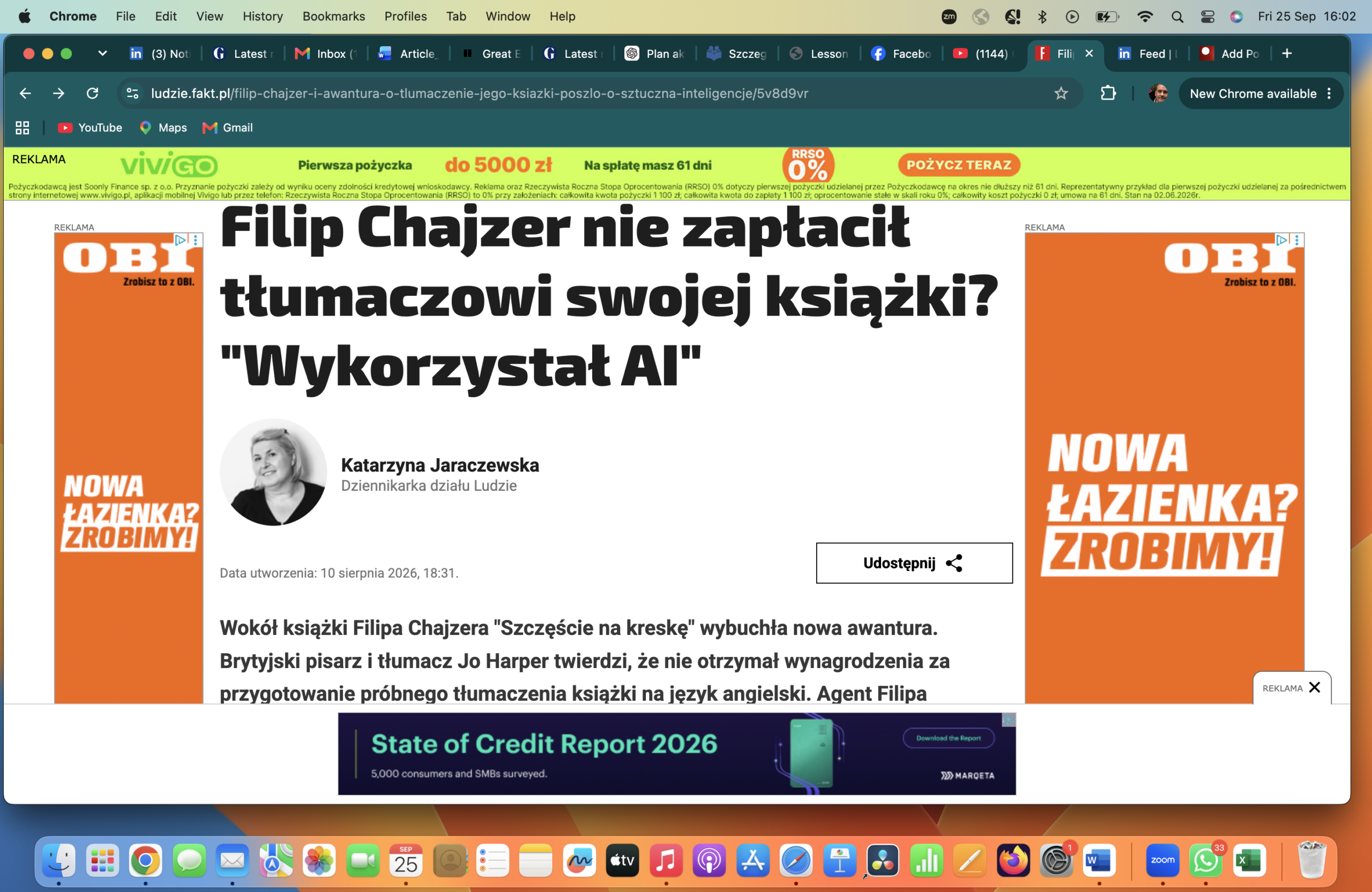
A few hours later, Fakt published another.
Both presented me as having spoken to Pudelek.
I say I did not.
That gives us our first testable proposition.
Did Jo Harper speak to Pudelek?
Not: Who is lying?
Not: Who do we like?
Not: What probably happened?
Did the conversation occur?
That is where the investigation starts.
What we currently have:
Pudelek wrote:
“Skontaktowaliśmy się z tłumaczem…”
“We contacted the translator.”
It then attributed to me a fairly detailed description of the assignment: the early editorial work, the chapters produced, discussion of payment and the subsequent dispute over AI.
I have no recollection or record of giving Pudelek an interview. I cannot find a telephone conversation, email exchange or message thread with its journalists.
I did, however, have a conversation with Chajzer’s representative in which I explained the working process in some detail. I have repeated it on my my website.
That may matter or it may not.
For now it is a lead, not a conclusion and that distinction is fundamental.
1. Establish the chronology
Before interpreting anything, build the timeline.
We currently have:
Stage 1: I begin work on the memoir.
Stage 2: I use ChatGPT openly during an initial analytical/editorial phase.
The purpose was to explore questions created by moving a Polish celebrity memoir into another cultural market:
- Who is the author to an English-language reader?
- Which cultural references travel?
- Which jokes survive?
- Which names require explanation?
- Is this translation, adaptation or an international edition?
The result was an analytical meta-document. Made by AI. Explicitly.
Stage 3: That approach is abandoned.
The subsequent instruction is essentially: stay close to the Polish text.
I translate seven chapters accordingly.
I still possess those seven chapters and the Polish originals. I can publish them too for those willing to wade through them.
Stage 4: A dispute develops over quality, payment and AI.
Stage 5: I explain my working process to Chajzer’s representative.
Stage 6: Pudelek publishes its article and says it contacted me.
Stage 7: A few hours later, Fakt publishes its version and twice describes my account as something said “w rozmowie z Pudelkiem”.
Stage 8: Fakt directly obtains comments from Chajzer’s representative but does not contact me.
Stage 9: Weeks later, I contact the Fakt journalist, Katarzyna Jaraczewska. She tells me she believed she had relied upon comments I had made to Pudelek. I tell her I had never commented to Pudelek.
Already we have something worth investigating.
2. Separate evidence from allegation
Now make four columns.
| Claim | Evidence | Status | What would test it? |
| Harper spoke to Pudelek | Pudelek says it contacted him | Disputed | Email, call log, messages, journalist testimony |
| Seven chapters were produced using AI and human-edited afterwards | Statement attributed to Chajzer’s side | Allegation | Chapters, originals, methodology, expert comparison |
| Initial analytical work used ChatGPT | Harper says so; meta-document exists | Confirmed documentable | Inspect document and chronology |
| Later chapters closely translated the Polish | Harper says so; texts exist | Testable | Side-by-side comparison |
| No payment/contract was agreed | Competing accounts | Disputed | Messages, invoices, files, chronology |
| Harper’s Pudelek comments may have originated elsewhere | Similar material appeared after conversation with representative | Hypothesis | Trace communications |
The key point is that every row has a different evidential status.
Do not flatten them.
3. Investigate the AI claim
The strongest allegation is unusually precise:
The seven chapters were allegedly generated using AI and subsequently corrected by a human.
Good.
Specific claims are useful because they generate specific questions.
Who made that assessment?
What exactly did they examine?
All seven chapters?
A sample?
The earlier meta-document?
Did they distinguish between the openly AI-assisted analytical document and the subsequent translation?
Was a professional translator consulted?
Is there a written assessment?
What characteristics were identified as evidence of machine generation?
Was an AI-detection system used?
If so, which one?
What result did it produce?
And what would such a result actually establish?
The obvious next investigative step would be to give the Polish originals and English translations, blind if possible, to independent professional translators.
Not: “Does this look like ChatGPT?”
But: How closely does this English track the Polish? Where does it depart? What kind of translation process does the textual evidence suggest?
I possess the documents.
So this part of the case is unusually testable.
4. Trace the missing interview
Now return to the simpler mystery.
Pudelek says it contacted me.
I say it did not.
How could we test that?
Check:
- my email;
- phone records;
- WhatsApp;
- Messenger;
- LinkedIn;
- SMS;
- website contact forms;
- the Pudelek journalist’s records;
- the article’s author notes;
- the exact wording attributed to me;
- whether that wording appears in my own article;
- whether it resembles what I told Chajzer’s representative.
Then ask Pudelek directly:
Who contacted Jo Harper?
When?
How?
Can you identify the communication?
No theory required.
Just records.
5. Follow the chain of command
Then comes the question I find most interesting.
How did the story reach Fakt?
Who commissioned it?
Did Katarzyna Jaraczewska pitch it?
Did an editor see the Pudelek story and assign a rewrite?
Did Chajzer’s representative contact Fakt?
Did Fakt contact him?
When?
Who supplied the lengthy statement?
Was it given by telephone or in writing?
Did the person commissioning the story instruct the journalist to contact both parties?
Was Pudelek treated as sufficient verification of my position?
Did anyone ask to inspect the underlying material?
This is where students must resist the temptation to leap to motive.
My own hunch is that the article may have functioned as closure: criticism appears, a representative gives a counter-account, AI supplies a clean explanation, the story is tidied up.
Perhaps.
But at present that is only my interpretation.
An investigation must be capable of killing its favourite theory.
6. Test the contract
Do exactly the same with the commercial dispute.
Do not ask:
Who sounds more convincing?
Ask:
What survives the documentary record?
Collect:
- messages discussing the assignment;
- references to three chapters;
- requests for further work;
- files sent and dates;
- references to price;
- invoices;
- reactions to completed chapters;
- compliments or objections;
- the first mention of AI;
- the first refusal of payment.
Then construct a timeline.
A contract is not proved because I remember one.
Nor does an agreement vanish because nothing was signed.
For our purposes the question is narrower: What did the parties say and do at the time?
7. What did Fakt actually verify?
Now return to the published article.
The class should identify which statements are:
directly reported,
recycled from another publication,
attributed allegations,
verified facts,
inferences, or
unknowns.
Then ask a very simple editorial question: If Fakt had contacted me before publication, what could it have checked within twenty minutes?
At minimum:
- whether I had spoken to Pudelek;
- whether the seven chapters existed;
- whether the earlier AI-assisted document was separate;
- whether there was correspondence about payment and continuation;
- whether I disputed the claim that AI generated the translation.
None of that would require Fakt to believe me.
Verification is not agreement.
The lesson
The point of this case is not Filip Chajzer.
It is not me.
It is not even ChatGPT.
It is the distance between: somebody said, we think, the evidence suggests, and we know.
That distance is investigative journalism.
Then we finish with five questions:
1. What can we state as fact right now?
2. What remains allegation?
3. What are we merely inferring?
4. Which missing document or conversation would most advance the investigation?
5. What evidence would prove our current theory wrong?
And then one final question, particularly appropriate for a publication called Fakt:
Did anybody check?

Leave a Reply