
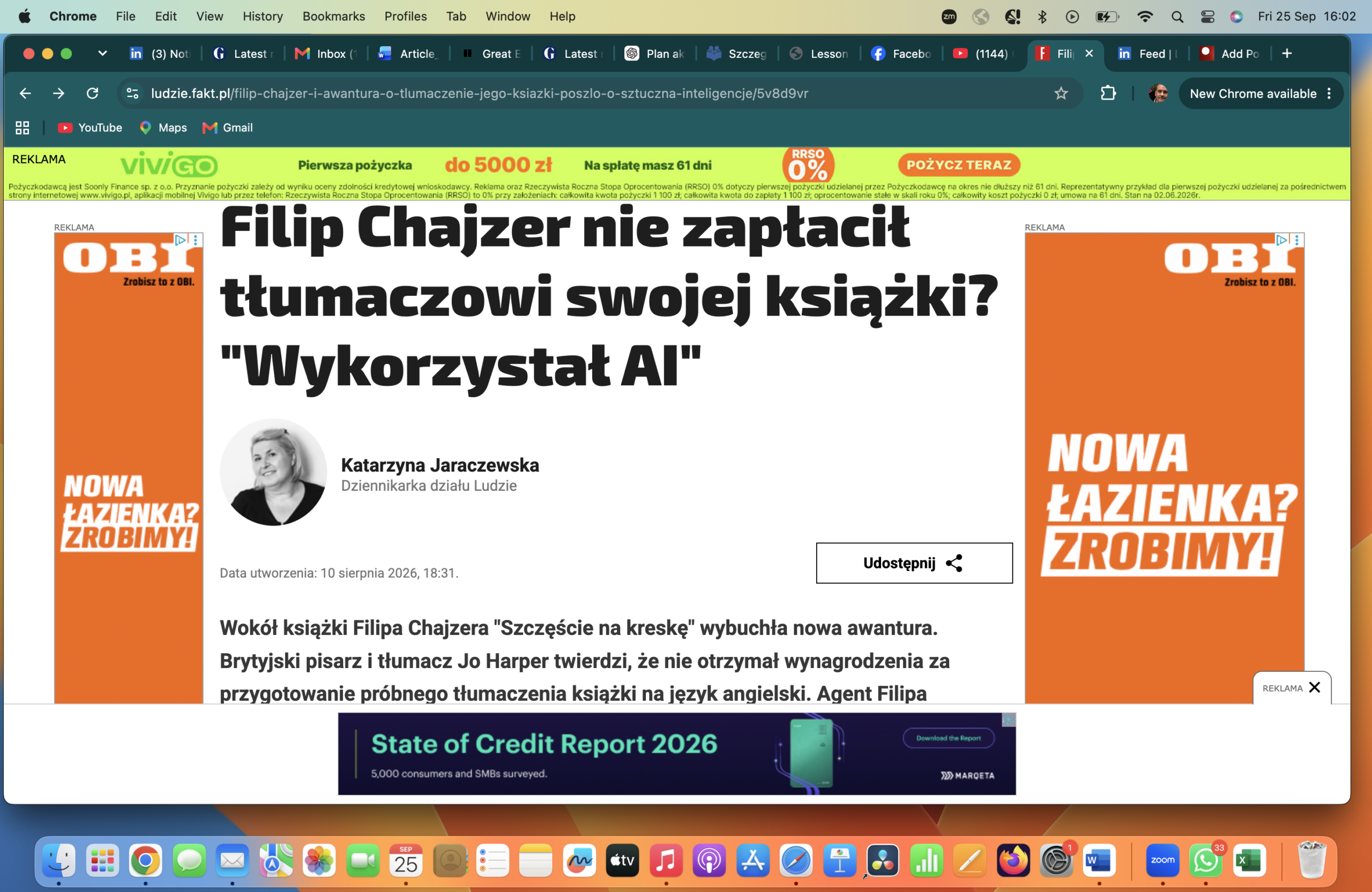
I don’t generally read Fakt. But today I did. And there I was. Famous. At last. Any publicity being better than no publicity, Broadway surely beckoned.
But sadly, this story starts with Filip again. Shucks, I thought I’d made the big time, ma!
So, let’s begin at the end, shall we?
On 10 August, Fakt journalist Katarzyna Jaraczewska published an article about my failed attempt to prepare an English-language version of Filip’s memoir, Szczęście na kreskę. Its headline distilled the matter efficiently: I had used AI. The article quoted his agent alleging that my translation showed extensive AI use, logical errors and unnatural phrasing, and had essentially been machine-generated and then partly corrected by a human. It did, kindly, mention my denial and the dispute over payment. But no-one called me up. I came up all tearful when I read that, ma. Shucks, does Pani Kasia not know how hurt my feelings were? And no coke to ease that pain.
But she had written a neat story. Almost impressively so. Done me up like a kipper, as we might say on Fleet Street.
I found Katarzyna on LinkedIn and asked her directly why she had not contacted me for my side of the story. At first she did not remember which article I meant.
“I really do write too many of these pieces,” she replied. Next she wrote that, as she recalled it, her article had referred to what I had said to Pudelek. This was news to me. I have never commented to Pudelek. I had not even heard of Pudelek before this little adventure. I told her so, and told her that if she wanted my account I remained available for comment. So, just for the record: whatever impression the Fakt piece may give, Katarzyna and I had no conversation before publication. Her understanding of my position came from somewhere else. I discovered hers when I read Fakt.
Still, perhaps that is the modern division of labour. Filip has the agent, Fakt has the reach, somebody else has the quote, and I have a website followed by approximately thirty-seven people and a surprising amount of free time in which to explain what actually happened.
So, since nobody asked me to respond to the detailed description of my working method before it was published, here is the tedious version.
The first document I produced for Filip was made with ChatGPT.
Explicitly and deliberately.
I told him.
It was not a translation.
It was a map.
This distinction is apparently more difficult than it sounds, so let us try again.
Filip had a Polish memoir of roughly 290 pages and wanted an English-language version, particularly one capable of travelling into an American market. Or British. Or Australian. He didn’t seem quite sure.
That immediately created a problem much larger than vocabulary.
Who is Filip Chajzer in America?
The obvious answer is: nobody.
That is not an insult. I am nobody in America too.
So the task was not simply Polish sentences into English sentences.
It was: What is this book when removed from the culture that produced it?
Which jokes survive?
Which references survive?
Which people require explanation?
Which anecdotes carry emotional weight only because a Polish reader already knows the protagonist?
Which bits of television shorthand evaporate completely?
How much context does an English-speaking reader need before explanation itself destroys the pace?
And, more fundamentally, were we producing a translation?
An adaptation?
An international edition?
A rewritten memoir?
Something between them?
These were editorial questions before they were linguistic ones.
So I put the whole book through an initial analytical process using ChatGPT.
I asked questions about structure, voice, cultural translation, repetition, narrative emphasis and audience. I drew on ideas about authorship and translation. I talked about ways of thinking about what happens when a text moves between contexts. Filip showed me pictures of his fiancee and told me his wedding plans. I’m not sure now if he was listening to my seminar on Roland Bartres.
Then I organised the results into a working document.
A meta-document. A map.
I printed two copies. I still have one at home. it cost 145 zlotys to print. It says “Meta-document” on the front.
There was no clandestine AI laboratory.
This I thought was a wise move. This is a bright man. My assumption was misfounded, as I was subsequently to discover to my misfortune, dear reader.
The idea was very simple. Here is the territory. Here are the difficulties. Here are the possible routes. Here are the places where literal translation may work. Here are the places where it probably won’t. Here are the places where Filip’s voice matters most. Here are the parts where an American reader is likely to shrug because the cultural reference doing the work in Polish does nothing in English.
Here, in other words, is our map before we begin the journey.
I explained what it was. I explained how it had been produced.
I had no shame about using AI then. I have none now.
AI was extremely useful at this stage.
That does not mean you hand it a Polish memoir at breakfast and collect the American bestseller before lunch.
Filip’s response to my proposed freedom in developing the English version was, essentially: ‘As much as you like. Just keep it “great.”‘ The assumption of course being that it was already great.
Fine.
Then, about a week later, he told me he did not understand the document.
Also fine.
Perhaps I had overthought it.
Perhaps the theoretical apparatus irritated him.
Perhaps Roland Barthes was not what was required at that particular moment in the history of Polish television memoir.
So we abandoned the map.
Plan B.
Translate the thing.
Keep close to the original.
And that is what I did.
No ChatGPT.
No Google Translate.
No miraculous robot.
Keyboard.
Screen.
Polish text.
English text.
Sentence by sentence.
Read.
Think.
Type.
Delete.
Type again.
Wonder what the fuck the sentence means. Go back to the Polish. Try again. The ancient artisanal craft of staring at words until different words appear.
Four chapters.
Around sixty pages.
For me, roughly two days’ work.
The rate discussed was 100 złotys per page.
Filip said he would show the material to friends in America.
Fine.
Then came waiting.
Weeks.
I asked whether he wanted me to continue.
Yes.
So I translated another three chapters.
Seven chapters in total.
Roughly a hundred pages.
And then eventually the verdict arrived.
The English sounded too Polish.
And also, as though it had been produced by AI.
I confess I admired the conceptual ambition of this. I had apparently invented artificial intelligence capable of sounding insufficiently artificial.
Or perhaps excessively Polish.
Possibly both.
An intermediary then called me. Friend, lawyer, representative, agent: by this stage the precise title seemed less important than the fact that yet another person had entered the translation.
My patience, meanwhile, had begun to leave it.
Eventually I told him to fuck off and shove the book where the sun don’t shine. Forgive me, ma!
Not a distinguished moment in British soft power.
But diplomacy requires stamina, and mine had expired.
Later, when the intermediary contacted me again, I wrote everything down.
Carefully.
The stages.
The first AI-assisted analytical document.
The subsequent human translation.
The distinction between them.
The purpose of the first.
The purpose of the second.
The question of audience.
The problem of voice.
The movement I had envisaged from relatively close translation towards a properly developed English-language version.
Because translating Filip’s words turned out to be the easy bit.
Translating Filip’s world was much harder.
That is the part I think got lost. Polish television culture had already done a considerable amount of invisible work for the Polish book. Names arrived preloaded. Filip too.
A Polish reader did not begin on page one asking: Who is this man and why am I supposed to care?
An American reader would.
That reader would know none of the television shorthand, none of the accumulated reputation, none of the tiny social signals surrounding Polish celebrity.
The story would arrive naked.
And once stripped of its local fame, it would have to compete with thousands upon thousands of memoirs about addiction, loss, celebrity, family, recovery, trauma and reinvention.
Again, not an insult.
A publishing fact.
The editorial question therefore becomes: What makes this story travel? That is where translation becomes something more interesting than substitution. The version I imagined would eventually have remained recognisably Filip’s. But it would not have been a photocopy. It would have been another artefact.
A book produced from the first book.
We never got there.
Filip was perfectly entitled not to like what I had done.
That point is almost embarrassingly simple.
He could dislike every sentence.
He could decide the project was misconceived.
None of that particularly interests me anymore.
What interests me is how the process was subsequently represented.
An openly declared AI-assisted analytical stage becomes: the translator used AI.
A map becomes the journey. The preliminary editorial exercise becomes the translation.
And then Pani Katarzyna has a headline and Filip’s reputation is salvaged from the gutter.
I had much less to protect.
I still don’t.
This is not my media ecosystem. This is not my country. I am not competing for a place in it. And, fortunately, it is no longer my problem.
Oh, and by the way, Fil’ old chap, you have the invoice and the money is still unpaid. Bank details unchanged.

Leave a Reply