
I never really thought my voice counted. Some things I said mattered, obviously. To people I loved. To people I hurt. To editors waiting for copy. But I never thought of my voice as a thing in itself, something that needed protecting or cultivating or, God forbid, branding. It did not require a loudspeaker.
I finished my PhD in 1999, when the internet existed but not yet in the sense that it exists now, as a permanent global vanity mirror into which everybody is required to shout. Writing a PhD was hard. Years of work, libraries, footnotes, revisions, arguments with dead people. Then you printed it, bound it, handed it over and, largely, nobody read it.
There was something healthy about that.
Then came journalism.
My first proper job in Poland was at The Warsaw Voice. I stayed for about a year. It was an education in lost voices: a tightly controlled publication whose wider function, as I understood it, was to present Poland to foreigners in an attractive and comprehensible way. Poland was young again, Western again, open for business. There was a story to tell.
Already I was slightly in the wrong place.
I had not come to Poland to tell its story for it. I had come to look.
That distinction has taken me almost thirty years to understand.
At Dow Jones Newswires I began learning what a journalistic voice was supposed to sound like. David McQuaid was my boss. I liked him very much. He was kind, funny, slightly eccentric, a decent man. But he was also, as I remember him, beholden to the machine. The machine had rules. Stories had forms. Markets wanted things. Gosia Halaba was there too, closer to its centre. I was an add-on.
After a year I was replaced.
It hit me surprisingly hard.
David suggested I might consider another career.
I didn’t. Perhaps because journalism was never quite my career in the first place. It was somewhere I stood while looking at something else.
I had come to Poland as an observer. Even while doing journalism, I was observing journalism.
Next came Interfax and Glenn Tyrpa, another American in Warsaw whom I liked. In fact, I liked many of the Americans I met in those years. They were less pompous than the Englishmen I had grown up around, less saturated in the little codes of school, accent and class by which the British recognise one another before anybody has actually said anything.
But the Americans had their own limitations.
There was a magnificent certainty to the American worldview. The Cold War had been won. Markets were not an ideology so much as gravity. Liberal capitalism was not one possible settlement among others; it was what happened when history stopped being silly.
The confidence was exhilarating.
It was also wonderfully provincial.
Then Reuters sent me to Gdynia as its northern Poland correspondent. I drove around northern Poland chasing whatever counted as news. Press conferences in Olsztyn. Leszek Balcerowicz saying something quotable. Warehouses exploding. Companies expanding. Markets moving.
I liked Wojciech Moskwa. I liked Douglas Busvine. They were proper journalists: alert, knowledgeable, generous, able to see a story before most people noticed there was anything to see.
And parts of it were tremendous fun.
But northern Poland did not produce enough Reuters news to sustain the arrangement, and the news it did produce increasingly seemed to me like rather thin fuel. Markets. Business. Industrial accidents. A sentence from a minister capable of moving a price by half a percentage point.
Meanwhile, outside the Reuters terminal, there was Poland.
That was what interested me.
After that I spent years editing a daily Sub-Saharan Africa newsletter for CEE MarketWatch in Bulgaria. Ventsi and Georgi were lovely people. I respected them. But I was not an Africa expert. I was an Englishman living in Poland editing other people’s reports about a continent I did not know sufficiently well.
Eventually that ended too.
By then I had acquired a dangerous professional habit: I had begun privately downgrading the work I was paid to do.
Paid drivel.
That is an unpleasant phrase, but it captures something real. The journalism paid. The things I cared about did not. So I cut corners on one while feeling vaguely heroic about neglecting it for the other.
This is not a good way to work.
Then Debtwire in London. Again, decent people. My boss, Nick, had a kind of innocence about him, though he was extremely clever. Then Mergermarket back in Warsaw and five years of mergers-and-acquisitions news.
Would a shoe manufacturer in Toruń list on the Warsaw Stock Exchange?
Perhaps.
Call them.
Call the adviser.
Call the private-equity firm.
Find somebody who knows somebody who has heard something.
Publish three hundred words.
Repeat.
Jurek was there, and I still think of him as perhaps the best journalist I knew in Warsaw. Shy, mumbling, almost invisible, encyclopaedic. Never performing journalism, just doing it. He always seemed to know where the information was and how to get there.
He taught me something important without ever saying it.
The best journalists are not necessarily the loudest ones.
Quite often the opposite.
But M&A was not my cup of tea. Five years of corporate courtship, financing rounds, listings, acquisitions and people saying “no comment” while meaning “yes, but not yet” was probably enough.
Then came Deutsche Welle.
That was the place I valued most.
Henrik Böhme and Hardy in the business department were funny, friendly and professional. I loved working with them. There were Australians and Americans who seemed open-minded, curious, relatively uninterested in policing the exact social pitch of a sentence. There was Rina, slightly crazy, fragile and strong at the same time, an extraordinary force of nature for whom I will probably always have a soft spot.
And there were other people.
An older English woman whose name I have now forgotten. Mark, another Englishman, who would rewrite my stories while I sat watching in increasing horror.
They were not bad people.
That was almost the problem.
English class bias rarely announces itself as class bias. It arrives as correctness. Tone. Taste. The proper word. The slightly raised eyebrow. The assumption that there is a naturally correct way of expressing something and that certain people happen, mysteriously, to possess it.
Those long night shifts became almost unbearable.
Henrik left.
Eventually I did too.
By then I was back in Warsaw, and journalism had begun to feel less like access to the world and more like an increasingly small series of rooms in which people discussed what the world ought to look like.
There was Emerging Europe. Its boss, an Anglo-Pole as I recall, seemed to me interested in a version of the region I found thin: aspirational, glossy, improving. Poland presented once again as a product requiring better packaging.
Then PAP.
Maria embodied, for me, something else I had encountered repeatedly in Polish institutions: insider confidence disproportionate to curiosity. Role became authority. Authority became knowledge. There were whispered rules, loyalties, little hierarchies, private understandings. A boss wrote romance novels in her spare time and tracked aeroplanes on her phone.
I remember wondering: why?
The world we were supposed to be reporting was right here.
Then Forbes, so badly paid that it almost invited sloppiness.
By then I had begun openly sabotaging the role.
Not the publication. The role.
I wrote about Marxism. About stupidity. About the possibility that journalists were nowhere near as clever as we imagined ourselves to be.
Apparently not everybody appreciated this line of inquiry.
I was fired.
Then the IPN in Warsaw: more gatekeeping, sanctimony, parcel-passing, favours, people knowing people, the performance of seriousness.
It didn’t last.
Then TVP World.
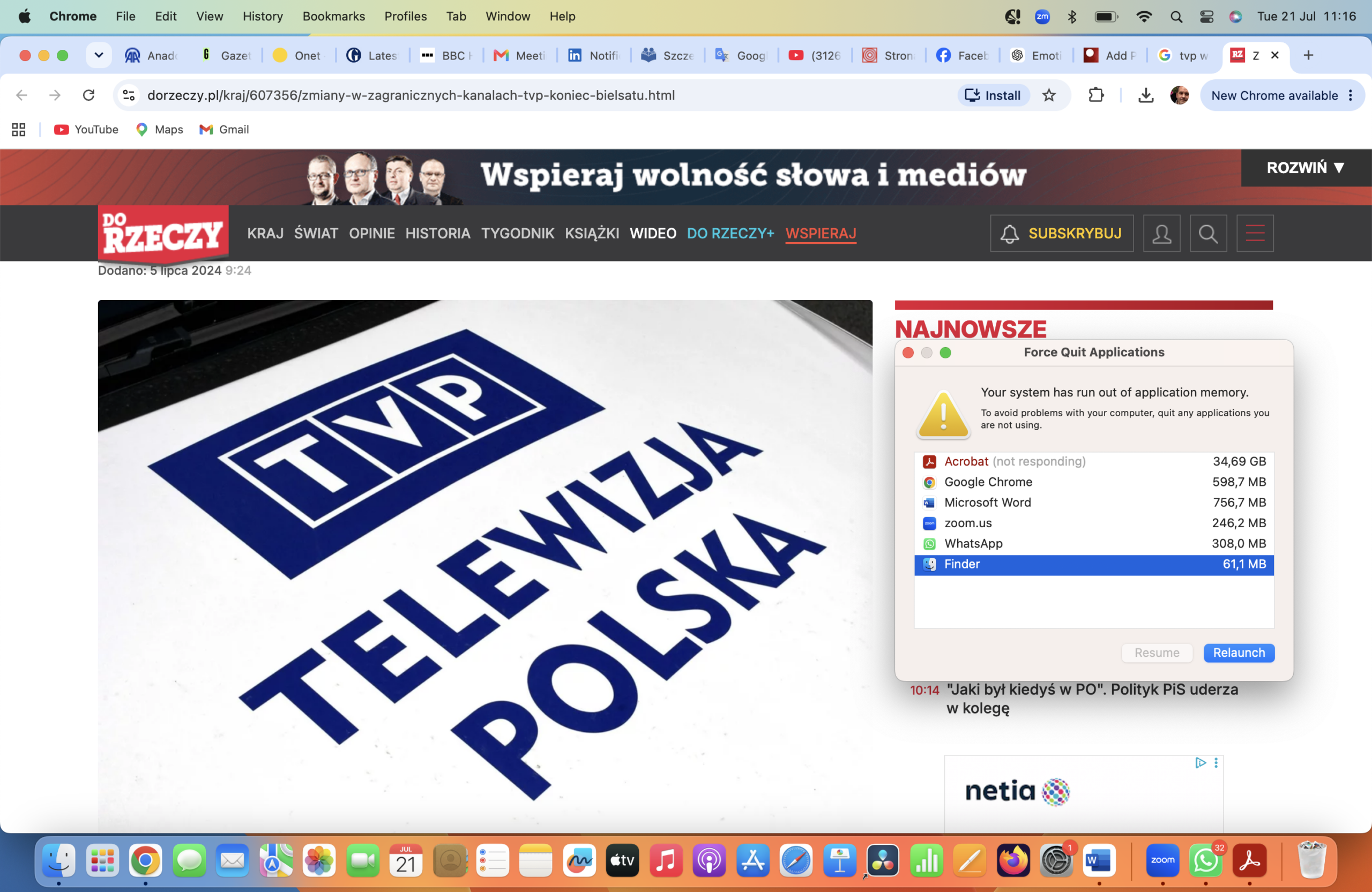
That was a world I simply did not want to inhabit. More whispering about Poland, more anxiety about presentation, more insistence that the country must somehow be defended through broadcasting.
I kept wondering the same thing.
Is Poland really so fragile that it requires this much looking after?
TVP World seemed to me performative and dull, a third-rate CNN operating inside a very small goldfish bowl while imagining itself international. Adam Yasser personified some of that world for me: an insider whose importance seemed much greater from inside the bowl than outside it.
Elsewhere there was Poland Weekly, Christian – surname temporarily lost somewhere in the ageing filing cabinet – and another glossy attempt to solve the same supposed problem.
Poland needed a better image.
Apparently.
I had by then lived here for decades and had begun to suspect that Poland’s image was probably the least interesting thing about Poland.
Politico work came and went. BBC pieces came and went. Other outlets appeared briefly and vanished.
The journalism industry and I were no longer travelling in the same direction.
And in the middle of all this, almost accidentally, I wrote books.
Four of them.
Some appeared in Polish. Some in German. Some found publishers. Some struggled.
But the books kept something alive that journalism increasingly did not.
The reason I came here.
The freedom to look at Poland without having to improve it, defend it, sell it, condemn it or compress it into four hundred words.
And once I recovered that distance, something else came back.
Affection.
Not affection for “Poland” as an abstraction.
For people.
Good people. Difficult people. Loving people. Suspicious people. Open people. People carrying histories they sometimes understood and sometimes did not. Ordinary people who could suddenly become exceptional for ten minutes over coffee and then go home.
That Poland never disappeared.
I had simply spent too much time in institutions telling me what Poland was.
Perhaps this is why I now find myself teaching journalism.
There is an irony there.
After nearly thirty years of doing it, leaving it, returning to it, resenting it, needing it, being paid badly by it, occasionally loving it and repeatedly being disappointed by it, journalism has finally become material.
The machine itself is now interesting.
Who decides?
Who knows?
Who gets believed?
Who acquires a voice?
Who loses one?
What happens to information as it passes from witness to reporter to editor to headline?
Why do mediocre people sometimes acquire extraordinary confidence while genuinely gifted ones mumble in corners?
Why does gossip become knowledge?
Why does status become evidence?
These are much better questions than whether the shoe company in Toruń is considering an IPO.
And perhaps that is the goodbye.
Not an angry one.
Journalism gave me a living, intermittently. It gave me friends. It gave me access to extraordinary places and people. It taught me speed, structure, scepticism and the value of the stupid question. It also taught me how rapidly curiosity becomes routine and routine becomes certainty.
For years I thought my problem was that journalism would not give me enough of a voice.
I now think I misunderstood the arrangement.
The voice was never journalism’s to give me.
It was mine.
It only took thirty years to notice.

Leave a Reply