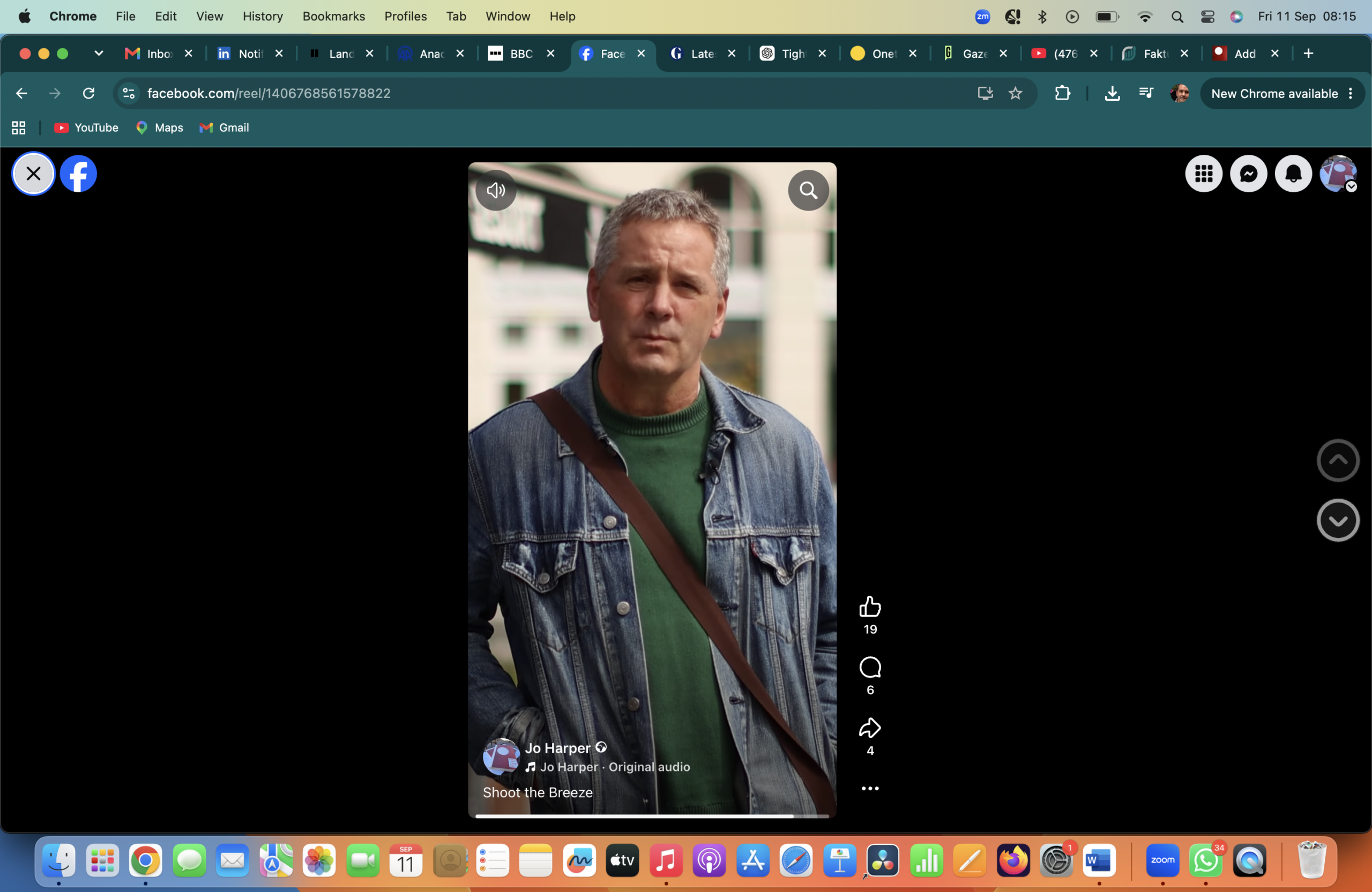
There I am walking around Warsaw, talking to camera, holding up books, appearing briefly on television screens. I look older than I think I look. There is a small gap between my teeth. I have more chin than I remember ordering. Sometimes I don’t open my mouth properly when I speak. I look away from the camera at odd moments.
That is me. Except obviously it isn’t.
It is forty-something seconds selected from much longer filming. There were other takes. Things I said badly. Sentences I stopped halfway through. Moments when I looked ridiculous. Bits where nothing happened. Someone chose what stayed and what disappeared. Images were arranged. The man who walks through the finished film has been edited into existence.
Would it be more authentic if we put all the bad bits back?
Probably not.
It would just be a different edit.
And that was what made me start thinking about artificial intelligence. Not because AI made the film. It didn’t. Because the problem suddenly looked familiar.
We keep talking about AI as though it has created an entirely new crisis of authenticity.
Did you write this?
Are those really your words?
But we have been asking versions of these questions for a very long time.
Long before ChatGPT.
Plato already had the problem. People chained in a cave watch shadows and mistake them for reality. Somewhere beyond them are the objects casting the shadows, and beyond those again the sun.
The usual reading is that somewhere behind appearance lies the real thing.
But it immediately creates another problem. How would we know when we had reached it?
Perhaps the unedited footage is more real?
But the unedited footage is still a camera recording.
Perhaps the real me is therefore the person who stood in front of the camera.
Except he knew he was being filmed.
So perhaps the real me is the person who went home afterwards, took off his shoes and made a sandwich.
Unless he was still thinking about how he appeared on film.
You can chase the authentic self backwards indefinitely and never quite catch him.
Lacan would have enjoyed this. For him, one of our earliest experiences of selfhood already involves something like an edit.
A child sees itself in the mirror.
There I am.
Except the image is outside the child. The body is experienced from inside as hunger, movement, frustration, sensation, bits and pieces. The mirror gives it a coherent shape.
And Lacan calls this recognition a misrecognition. Not because the child has mistaken itself for somebody else, but because the coherent thing it recognises as itself is already an image.
We spend the rest of our lives doing versions of this.
Mirrors.
Photographs.
Job titles.
CVs.
Facebook pages.
Books.
Political identities.
National identities.
Other people’s descriptions of us.
We look at them and say: Yes, that is me. Then occasionally we look again and think:
Christ. Is it?
AI enters an already crowded room.
I use ChatGPT. I use it to edit. To question things. To rearrange material. To test arguments. Sometimes it suggests a phrase. Sometimes a paragraph. Sometimes it produces something I immediately delete because it sounds like ChatGPT.
And increasingly I can hear that sound.
There is a cadence, a certain neatness, the balanced sentence.
You can spot it. Sometimes.
But then I can also spot newspaper style. Academic style. BBC style. Corporate style. American style. My father’s phrases. Things I learned at school. Words I picked up in pubs. Bits of Polish syntax creeping into English after thirty years.
Which of those is my authentic voice?
Language was never private property.
Words do not carry meaning around individually. They acquire meaning through differences and relations. A word means something partly because it is not another word.
We enter that system. We do not invent it.
Nobody sits down at the age of two and designs English. Language is already there waiting for us. It gives us the material with which we eventually announce that we are unique.
This is already quite funny.
I express my individuality using words used by millions of other people.
And so, who is the author? Barthes famously killed the author. Not literally. His point was that we place too much authority in the person whose name appears above the text.
We ask what the author intended. What did he really mean?
But texts are made from existing language, cultural forms, references, conventions, quotations, genres.
The author is not God standing outside language creating meaning from nothing. Meaning happens between text and reader.
That argument suddenly feels rather less abstract because now we actually have machines producing text from gigantic bodies of existing language.
And understandably people find this disturbing.
If a machine can produce a competent newspaper article, university essay, poem, advertising campaign or love letter in seconds, what exactly was the writer doing?
That question can be uncomfortable. Especially if you are a writer.
But perhaps it exposes something rather than destroys it. Writing was never simply the production of words.
Eric Morecambe explained this rather better than most literary theorists.
“I’m playing all the right notes, but not necessarily in the right order.”
That is more or less writing.
We know the words, most of them anyway. The problem is the order.
A machine knows an extraordinary number of words and is exceptionally good at putting them in plausible orders.
What interests me is not whether that means the machine has become human.
I am genuinely interested in the larger question. Could systems become sufficiently autonomous that human beings lose meaningful control?
But there is another, smaller question underneath them. What exactly are we protecting when we say AI threatens the human?
An authentic self? An authentic voice? Original thought?
We have always been mixtures. Language speaks through us as much as we speak through language. That does not mean individual people do not exist.
Perhaps the individual is less like an original source and more like a strange intersection.
The self may be something assembled rather than discovered.
That is where AI becomes interesting to me.
Not as a replacement for the self, but another element entering its assembly.
That creates another Lacanian problem: the subject supposed to know.
We like to imagine that somewhere there is somebody who knows.
The analyst.
The professor.
The doctor.
The editor.
The intelligence service.
The government.
The lover.
God.
Now perhaps the machine.
And human beings are already extremely vulnerable to confident language.
We always were.
AI did not invent bullshit.
Which means the old questions remain useful.
How do you know?
What is the evidence?
What would prove this wrong?
What are you assuming before you begin?
Those are journalistic questions.
They are also psychoanalytic questions.
And now they are AI questions.
Perhaps skepticism is one of the things we need most.
Not skepticism meaning that nothing is true.
The opposite.
Skepticism as a refusal to confuse a convincing representation with the thing itself.
Including representations of ourselves.
I look at the film again.
There is Jo Harper walking down a Warsaw street.
He seems reasonably relaxed.
He knows roughly what he wants to say.
The editing helps.
There are no failed takes.
No silences long enough to become uncomfortable.
No one has included the moment when he forgets what he was talking about.
Films have always worked like this.
Writing does too.
Every finished article conceals the deleted paragraphs.
Every book hides discarded chapters.
Every photograph excludes what lies outside the frame.
Every sentence kills several sentences that might have existed instead.
Editing is not the opposite of authenticity. It is one of the ways meaning gets made.

Leave a Reply