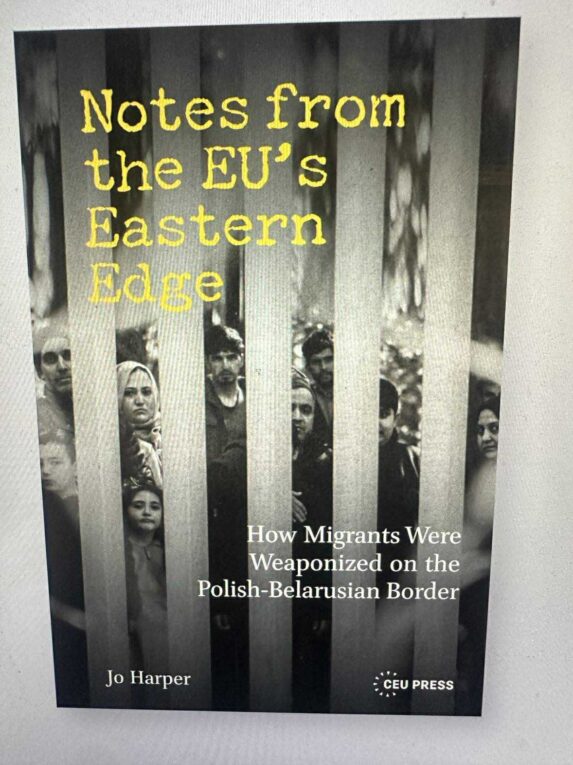
When I wrote Notes from the EU’s Eastern Edge, published in May, I thought I was writing about a border.
More precisely, I was writing about what happened when several thousand people from the Middle East, Africa and Asia appeared on the Polish-Belarusian frontier and became incorporated into a much larger drama involving Russia, Belarus, Poland, the European Union, migration, memory and war. The border seemed less a line on a map than a screen onto which Europe projected anxieties it could not otherwise contain. In the book I described it as a place where sovereignty, historical trauma and political identity collapsed into one another: somewhere Europe tried to establish who belonged by making somebody else carry the burden of not belonging.
I still think that.
What has changed is that I understand the argument differently.
A border is not necessarily evidence of pathology. Neither is a nation. Neither, for that matter, is fear. There are things worth defending, people from whom one needs protection, memories that should not disappear and institutions without which solidarity becomes little more than sentiment. The mistake is not to have a border, but to ask the border to make us whole.
That distinction was already in the book, although I now see it more clearly than I did when I wrote it. In a chapter on Polish trauma I contrasted two responses to insecurity: one that repeatedly performs the wound, and another that attempts to mourn it. But even there I wrote that the latter “does not deny the need for borders or for security; it refuses to make them sacraments.” The choice, I suggested, was not between security and empathy but between “acting out and acting responsibly.”
That now seems to me the book’s central proposition.
It is also becoming harder to sustain.
Russia’s war against Ukraine has not disappeared into theory. In recent days Russian drones have struck targets close to Poland’s frontier with Ukraine, prompting Warsaw to reinforce infrastructure at border crossings. European governments are simultaneously discussing new mechanisms for responding to sabotage, drone incursions and other forms of hybrid attack, against a background of increasing uncertainty about how far the United States under Donald Trump can be assumed to underwrite European security in the old way.
The footsteps outside are sometimes real.
Psychoanalysis becomes useless if it is reduced to telling frightened people that the thing they fear is merely a projection. Lacan’s more unsettling point is almost the opposite. Reality and fantasy do not politely divide themselves into separate rooms. A real threat can become the object around which fantasy organises itself. An imaginary threat can produce entirely material institutions, walls and weapons. A community can correctly identify danger and still make that danger perform psychic work for which it was never designed.
Russia can be dangerous and Poland can be traumatised by Russia. Both can be true.
A migrant can be instrumentalised by an authoritarian state and remain a human being entitled to dignity. Both can be true.
A border can require defence while simultaneously becoming a theatre in which a nation performs fantasies of purity, courage and coherence. Both can be true.
The difficulty lies in keeping both propositions alive.
This was what interested me about Poland in the first place. Poland has occupied an unusually unstable place in Europe’s imagination: heart and edge, East and West, victim and actor, backward pupil and exemplary European, bridge and wall. I described it in the book as alternately sponge, hedgehog and attack dog, a country onto which Europe projects its own uncertainty about whether it wishes to be a fortress or a communicative space.
The categories keep changing because Poland does not quite stay where Europe puts it.
For decades after 1989, Poland was supposed to be catching up. Western Europe possessed the future. The West had institutions, prosperity and post-national sophistication. Poland had borders, priests, uprisings, Russians, Germans, graves and an apparently inexhaustible supply of historical grievances.
Then history returned. Russia invaded Ukraine. Borders mattered again. Armaments mattered. Geography mattered. American power mattered. Energy dependency mattered. Polish suspicions that had once sounded excessive became rather less easy to dismiss.
The temptation now is simply to reverse the hierarchy. Poland was right; Western Europe was naïve. But that is precisely the sort of satisfying closure the book warned against.
Polish vigilance contains knowledge. It also contains fear. Polish historical memory contains wisdom, but also fantasies of innocence. The country’s experience of abandonment, partition, occupation and externally imposed political orders helps explain why sovereignty has such emotional force. It does not automatically sanctify everything done in sovereignty’s name.
Indeed, the book’s argument was that trauma operates simultaneously as shield and weapon. It can produce solidarity with others because one recognises suffering. It can also justify exclusion because vigilance itself becomes a moral virtue. The past ceases to recede and instead circulates, repeatedly activated as proof that vigilance must never end.
That is melancholia rather than mourning. Mourning does not mean forgetting. It means that loss ceases to require continuous reenactment in order to remain real.
This was the distinction I tried to make between the Monological Temple and the Democratic Agora. The first sacralises the wound, the second talks about it. Yet even that opposition now seems too clean to me. Churches can contain pain. Ritual can prevent suffering from becoming formless. The secular liberal promise that everything difficult can eventually be processed through institutions, scholarship, apology and dialogue contains its own fantasy of closure. The Agora also has its liturgies.
That is why the book eventually argued that Poland is not really divided into two coherent Polands, liberal and nationalist. The division passes through one political subject. Liberal Poland needs nationalist excess against which to define its reasonableness and Europeanness; nationalist Poland needs liberal dependence on external recognition against which to perform sovereignty. Each provides the other with the antagonist it requires. At the border, the apparent opposition narrows further: rhetoric changes, but fences remain, exclusion zones remain, security practices converge.
This is the Lacanian point that still interests me.
We do not simply possess identities. We construct ourselves through what we imagine the Other sees when it looks at us.
Poland wants Europe to recognise it as European while resenting the terms on which that recognition is offered. Europe wants Poland to confirm the superiority of a post-national order while increasingly relying upon Poland’s geographical and military position to defend that order. Russia needs Poland as evidence of Western hostility. Poland needs Russia, at least symbolically, as the recurring proof that vigilance was justified.
Nobody occupies an external position.
The mirror keeps reflecting the mirror.
And perhaps this is where I have returned to the book from somewhere I did not expect.
For several years I thought of these questions principally as political ones: borders, nations, migrants, memory, belonging. Increasingly I think they are questions about how to live.
What is a self without a border?
Probably not much of a self.
But what happens when the border becomes so rigid that nothing can cross it?
What is belonging without solidarity?
What is solidarity if it requires the disappearance of the person offering it?
What does it mean to love a country, an institution or another human being without asking that object to repair what is missing inside oneself?
Lacan offers no happy ending to any of this. There is no recovered wholeness waiting on the other side of sufficient analysis. Lack is not a design fault. The mature subject is not the person who finally becomes complete but the person who becomes less frantic about incompleteness.
I think I understood that intellectually before I understood much of it elsewhere.
The book contains a phrase I now like more than when I wrote it: the possibility of learning to “inhabit identities without being possessed by them.” Poland’s experience of fracture, I suggested, might offer Europe something more interesting than either nationalist certainty or liberal embarrassment: a way of living without guarantees, acknowledging that institutions and identities are necessary without pretending they are eternal or whole.
That now seems less like an observation about Poland than an ethic. Have a border, but don’t worship it. Have an identity, but don’t mistake it for a complete description of yourself. Remember injury, but don’t require its repetition to prove that it happened. Defend what matters, but know what you are defending. Belong somewhere without requiring somebody else to be expelled so that you can feel at home. And perhaps most difficult of all: accept that solidarity does not mean dissolving oneself into another person, nation or cause.
Europe’s eastern edge remains a useful place from which to think about this because nothing there stays comfortably theoretical. Russian missiles and drones exist. Ukrainian dead exist. Migrants freezing in forests too. Polish memories of invasion and abandonment exist. So do racism, political manipulation and the temptation to convert legitimate fear into a permanent moral permission slip.
The contradiction cannot be solved by choosing one half.
That is what I would change least about the book.
Its central question was never really whether Poland should have a harder or softer border. It was what work we ask the border to perform when other forms of certainty have failed.
In the postscript I wrote that “borders, mirrors and machines will remain.” I no longer think the task is to overcome them. It is to become conscious of what we put inside them.
That applies to Europe.
It applies to Poland.
And, inconveniently, it applies to the rest of us.
The eastern edge is not where Europe ends.
It is where Europe repeatedly discovers that it was never as self-contained as it imagined.

Leave a Reply